

Collection Management Courses

ISR - 303 MTTs (ATRRS Inputted)
Courses are tailored to unit’s OE focusing on employing joint theater ISR processes, products, and airborne assets

Fundamentals of Collection Management
(3–5-day)
Provide a working knowledge of Joint intelligence requirements development, collection planning, asset tasking and directing, assessing collection, and updating the collection management plan. ISR-303 provides a sound doctrinal basis combined with current best practices being applied in a Joint environment. This Course is Designed for BN and Higher level Echelons. Unclassified JISR Fundamentals of Collection Management Training can be conducted located on Army BlackBoard at this Link.
Advise & assist staffs on OE focused and specific Joint ISR Capabilities including current best practices (OE Tailored)
- Developing PIR/SIR, developing EEI/NAIs/TAIs
- Understanding of ISR assets and their capabilities/limitations
- Understanding the systems, documentation and products associated with ISR operations
- Asset tasking / Requests for Collection
- Providing proper mission feedback supporting MOP and MOE
- Understanding the Collection Management process to meet Commander's intent!
Prepare individuals to effectively plan, request, employ, target, and manage airborne-ISR assets at the Joint Task Force and Component level— trains how to ITC airborne tactical and theater level assets
- Effectively employing all airborne sensors to meet Commander's intent
- Applying a fused Intelligence discipline approach to Target Development and Intelligence Planning in specific Operational Environments (OEs)
- Tracking patterns of life (POL) and patterns of activity (POA) for enemy networks in their respective AOs
- Find/fix targets in support of kinetic/non-kinetic targeting for LSCO, Hybrid, and Asymmetrical threats
Collection Operations Management (COM)
(5-day)
Joint Publication 2.0
Apply the fundamentals of JISR COM and JISR targeting principles – execution of ISR Sensor Tasking Authority
(training only)
Joint Engagement Team Training
ISR JETT Course
(CTC Pre-Rotational Training)
The T2COM G2, ISR Integration (ISR-I), Combat Training Centers (CTC) mission is to improve the integration, interoperability, & effectiveness of Joint ISR & Joint Fires. The JISR Team provides coaching, teaching & mentoring to Rotational Training Units (RTU) and replicates HICON Collection Management at all CTCs. Focusing on the Brigade Combat Teams (BCT) operating in a Highly Contested Environment (HCE) within a Large-Scale Combat Operation (LSCO) environment nested to Multi-Domain Operations (MDO).
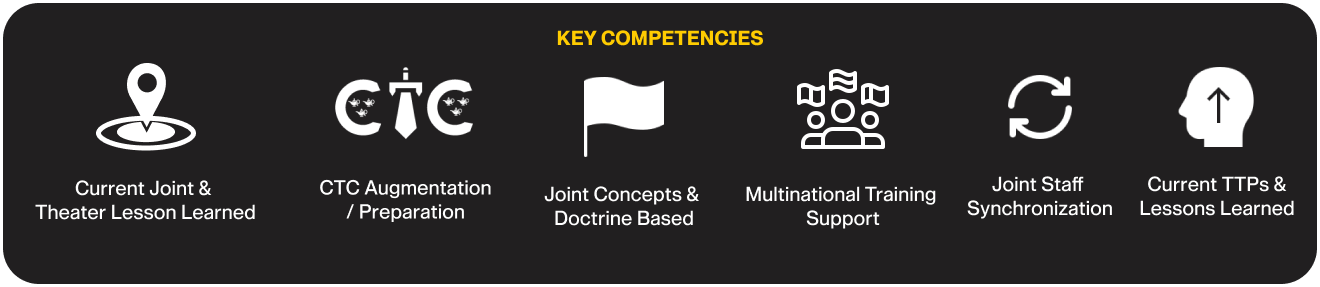
KEY COMPETENCIES


Joint Engagement Training Team (JETT)
Joint ISR / Joint Fires
(MTT / SVTC / MS Teams)
Pre rotational training event (in-person or remote) provided post Leaders Training Program (LTP)
- A tailored two-day course providing leaders & staff primaries a venue to “Deep Dive” into CTCs prior to the unit's arrival
- Provides an in-depth overview focused on the Intelligence & Fires Enterprise (sensor to shooter)
- Breakout sessions by enterprise to identify challenges, trends, & potential remedies
- A culminating working group that socializes friction points & potential mitigation opportunities
Hosted by a team of JISR and JFIRE SMEs aligned to the respective CTC (JRTC, NTC, or JMRC)
- Doctrine based approached serving as the baseline built upon the current Operational Framework
- Supported by current “Best Practices” in use at the CTCs supplemented with viable TTPs (planning through execution and assessments)
- Crosswalk of the Sensor to Shooter linkages within the D3A process
- Solutions focused promoting a permissive joint fires environment with layered collection operations enabling maneuver and informing Commanders through the MDMP process
CTC Subject Matter Experts (SME) Hosted Key Leaders and Primary Staff Driven